 |
Cologne, Germany, March 6, 1945.
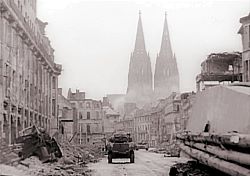
The 3rd Armored Division tanks advance on the Cologne center and the cathedral. It's about 2 pm.
The following minutes will produce some of the most dramatic combat images to come out of WWII.
This page will show you the famous tank battle at the Cologne cathedral. |
|
| |
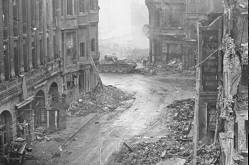
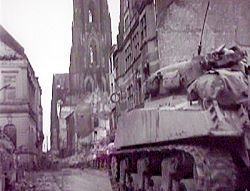  Coming from western city districts, passing the city areas around Venloer Strasse, Friesenplatz, Friesenstrasse and Zeughausstrasse, a group of several US-tanks approach the central square in front of the cathedral. Big mountains of rubble on the Komödienstrasse prevent the further advance of the tank group. They have to stop only 120 m / 395 ft away from the place where the street leads into the central square. Coming from western city districts, passing the city areas around Venloer Strasse, Friesenplatz, Friesenstrasse and Zeughausstrasse, a group of several US-tanks approach the central square in front of the cathedral. Big mountains of rubble on the Komödienstrasse prevent the further advance of the tank group. They have to stop only 120 m / 395 ft away from the place where the street leads into the central square.
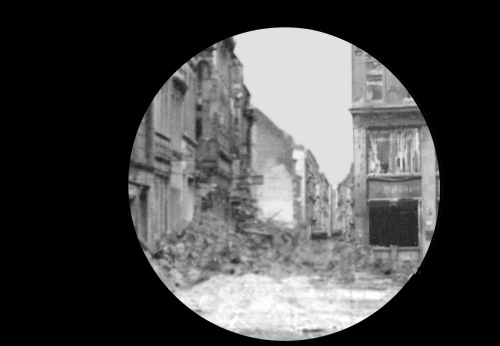
 Image montage: the US-tanks approaching the cathedral square can not be overlooked by the Germans. On the Komödienstraße there is a lot of debris, but the cupolas of two tanks surpass the debris. Image montage: the US-tanks approaching the cathedral square can not be overlooked by the Germans. On the Komödienstraße there is a lot of debris, but the cupolas of two tanks surpass the debris.
|
| |
|
1.) Skirmish Panther vs. Sherman
|
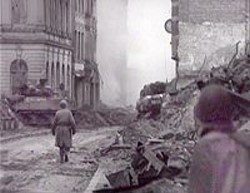
One M4A1W76 Sherman tank (right) and one M4A3W75 Sherman tank (left) from F Co, 32nd A.R., 3rd AD are standing on Komödienstrasse next to street Andreaskloster (at the left side). | |
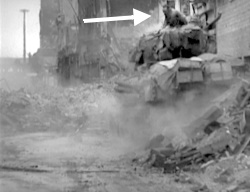
Suddenly a shell from a German Panther tank hits the leading US tank. Then a second one hits. A member of the crew, tank commander Kellner, tries to flee out of the tank.
|
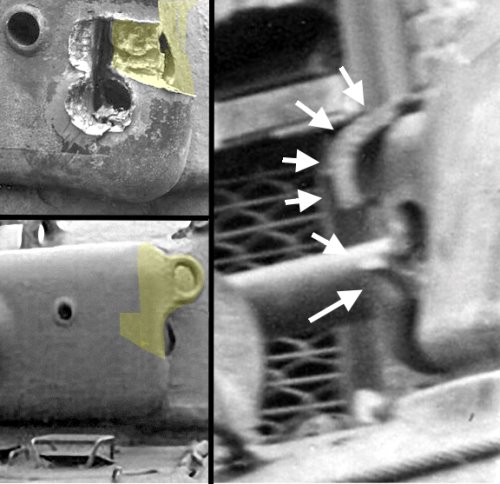
Two hits in the area of the gun shield. On the two left pictures in color the area in which the shield was deformed or blown off. The picture on the right shows a view from obliquely behind. You can see very well the demolition edge in the upper part. In the lower part one can guess the missing piece of the shield.
|
Where did the shots from come ?
There's a picture taken by George Silk when the battle at the cathedral was over. It shows the Sherman and in background the german Panther, which had hit the Sherman. On the right side there's the Sherman and in background the burning Panther at street crossing Marzellenstrasse. He is really good to see there. 
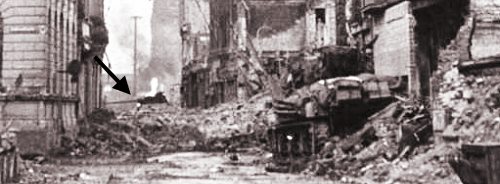
Excerpt of a picture made by George Silk, Life Magazin
And now a comparison with movie sequences before and after the hits:
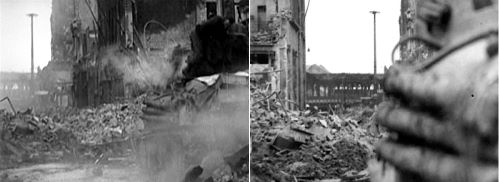
In the background there's no Panther shortly before (right) and shortly after the hit (left), where one can see the Panther on the Silk photo later. So, where was the Panther located when he had hit the Sherman ?
|
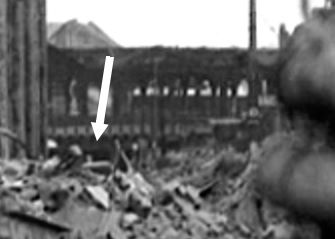 In the background one can see a tunnel under the central station. It's the street tunnel Trankgasse. In the background one can see a tunnel under the central station. It's the street tunnel Trankgasse. |
|
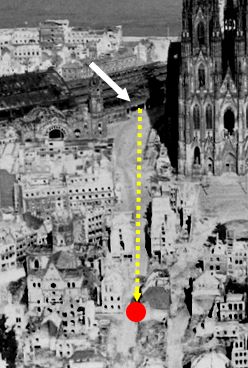 | When the Panther had shot he probably was located in or near the dark tunnel (white arrow) and the US troops were not able to see it there before. The red point is the place where the Sherman was located - distance tunnel / Sherman: 340 m / 1.115 ft.. After the hit the Panther was driving to the crossing Marzellenstrasse where he later was destroyed (distance Panther there / Sherman: 120 m / 395 ft.. There are records saying the Panther was already located at the crossing when the Sherman reached Komödienstrasse and they thought it was knocked out. But this seems to be unrealistic. Tank crews typically will not take it for granted that a tank in no mans land would be knocked out. They would shoot at it until it burned, which is what the Sherman crew would have done if the Panther was in sight on the crossing Marzellenstrasse. Following several sources the German tank Mark V (Panther) Ausf. A was from Panzerbrigade 106 "Feldherrnhalle". |
Back to the Sherman in Komödienstrasse after the hits:
|
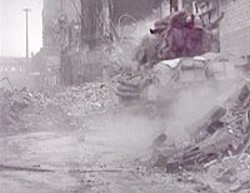
The tank smokes from the inside. One hit had cut off the soldier's left leg below the knee.
| |
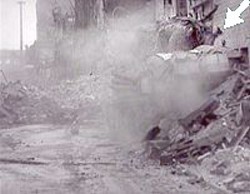
Behind the tank commander Kellner, who is creeping out, a second soldier falls down from the tank
|
| 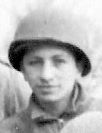 The second soldier seems to be 19 years old Corporal 'Gunner' John J Gialluca of the 3rd Armored Division 'Spearhead'. His son Doug found my site on the web and sent me the following mail where he describes the situation as he heard it from his father: The second soldier seems to be 19 years old Corporal 'Gunner' John J Gialluca of the 3rd Armored Division 'Spearhead'. His son Doug found my site on the web and sent me the following mail where he describes the situation as he heard it from his father:
The last tank battle in Cologne Germany on March 6 1945 happened as Corporal Gunner John J Gialluca approached the square of town between two buildings where suddenly by surprise a Panther Mark V hit their Sherman tank. John remembers the tank burning and they were trapped. The shrapnel went through his legs and he said he was pinned to his seat when a second blast under the turret forced him free from his position. There were no other survivors except Corporal John J Gialluca. There was another tank disabled next to his tank that tried to help the injured. They found John lying on the ground with his 45 caliber hand gun in his hand. Then John said as they were helping him he could hear the blast and gunfire from what is known now the battle of the last tank. The Sherman tank that Corporal John J Gialluca was in was facing the cannon of the 75mm high velocity Panther Mark V. The 76 mm is questionable as for penetrating the heavy armored Panther head to head. This was John's second tank hit in his journey from Normandy Beach and very fortunate to survive. Corporal Gunner John J Gialluca was sent to a hospital in England where he had a lengthy recovery and was able to walk again. After a long fight with kidney cancer John went to be with the Lord on July 5th 1998.
|
|
Contrary to the memory of John J Gialluca there's another crew member who survives the attack too, it's Oliver Griffin, the assistant driver.
So the Sherman crew was:
|
 Tank Commander Kellner Tank Commander Kellner
Gunner Gialluca
Asst. Gunner Speer
Driver Patrick
Asst. Driver Griffin
|
|
Once again the exit of Gialluca:
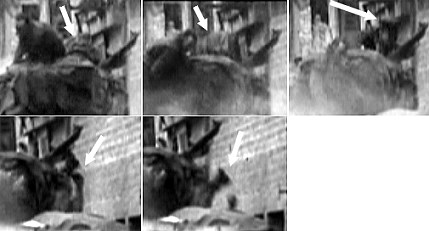
At the beginning of the movie scene Gialluca is already located on top of the cupola. One can see the torso and the head. Then - picture top middle - Gialluca wants to jump down from the tank, showing his bottom. Next pictures: he jumps down headfirst, one can see his legs stretched upwards.
|
Another detail:
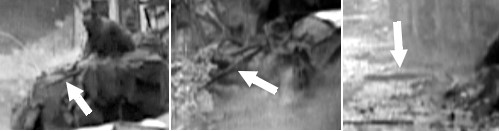
When Kellner leaves the cupola he holds a rifle in his hand. But he loses it and the rifle falls down onto the street next to the Sherman.
|
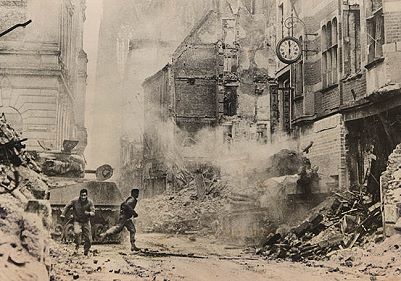
Courtesy of The U.S. Army 3rd Armored Division History Website. Photo by Fred Ramage/Getty Images
The crew of another Sherman tank standing on the left side of the street tries to help the other crew. |
The soldiers and a medic try to help Kellner in a bomb crater near the Sherman, but he passes away 
The driver Patrick and the loader Speer die just when the shell hits.
On the Gettyimages website there's a picture showing the dead Patrick sitting on the driver chair, head outside the driver hatch, in addition the two bullet holes.
|
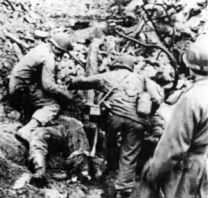
Source: Magazine "After the Battle #104"
|
|
PFC (Private First Class) Julian H. Patrick was born in Magoffin County, KY, on April 29, 1921. He was the youngest of 4 brothers serving in WWII. The three other brothers survived WWII. Julian was first buried in Belgium, his body returned in 1947 to the USA and interred in the family cemetery in Salyersville, KY.
|
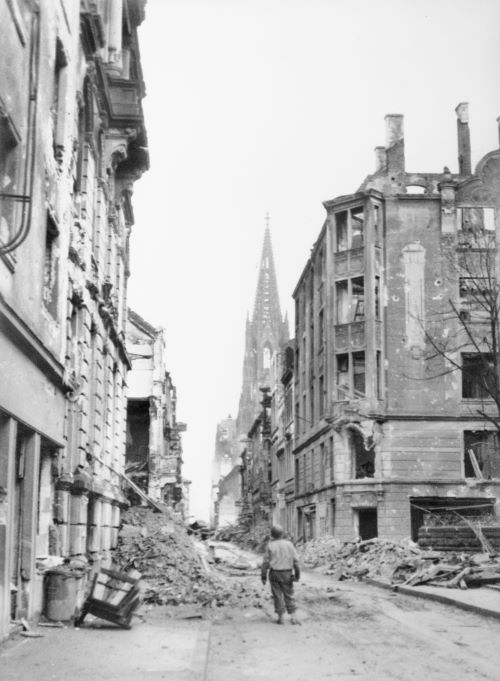
Photo courtesy of Australian War Memorial
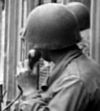
An US Army soldier is looking down the street Komödienstrasse, where the Sherman just had hit. The Sherman and its crew had passed this area where the soldier now stands just a few minutes before, not knewing their imminent end... |
Only the two Sherman crew members Griffin and Gialluca survived the incident with injuries.
|
|
2.) Skirmish Pershing vs. Panther
|
|
In a parallel street the US-troops from E Co, 32nd A.R., 3rd AD hear about this incident in Komödienstrasse.
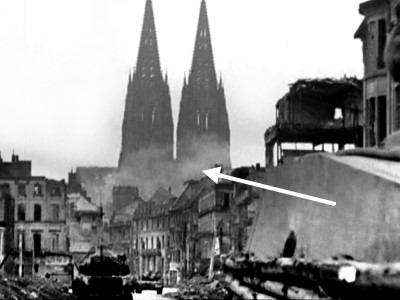
They just have reached street Gereonstrasse, when the Sherman on Komödienstrasse was hit. Smoke goes up from that area (arrow).
They move forward to street An den Dominikanern...
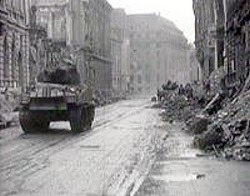 
... and receive the command, to approach and attack the Panther tank with the help of a Pershing tank
The lurking Panther
|
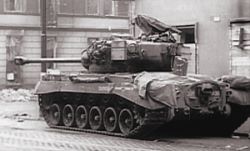
The T26E3 Pershing tank
|
|
|
What happened the last minutes before the upcoming tank duel ?
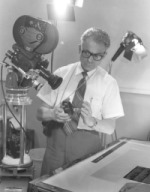
The US troops are only 200 - 300 m away from Marzellenstraße which leads to the central place at the cathedral where the German Panther tank now is located. US Army Signal Corps cameraman Jim Bates wants to film the upcoming tank duel.
Jim Bates:
|  |
Courtesy: photos.ppld.org, Special Collections, Pikes Peak Library District, 161-3315.
Jim Bates 1972
|
|
A Tank Commander named Robert Early from E Company 32nd. Armored Regiment went on foot to investigate. I asked to go along and we went on the mezzanine of a building and saw the tank. He told me to stay there and he would come back in his tank and try to put the German tank out of commission and I could photograph it. He had one of the new M-26 Pershings with a ninety-mm gun. Sgt. Early said he would turn into the square under me, stop and fire at the German tank.
Source: Website by Charles R. Corbin Jr.
|
| 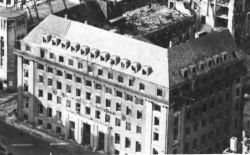
This is the building of the Deutsche Arbeitsfront, where Bates and Early watched the German tank and the surroundings.
|
| |
|
At this time the German Tank crew is waiting what happens and observes the surroundings.
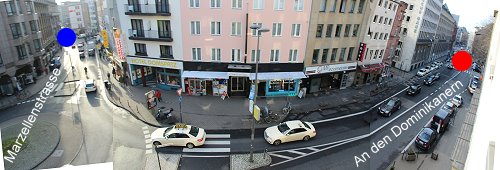
View today from the window where Bates took his famous movie. The blue dot was the place of the Panther was lying in wait for the enemy. Red dot the place where the US-troops were waiting in Street An den Dominikanern.
When Early comes back to his tank he gives last instructions to his crew and starts the mission. The Pershing tank approaches the crossing An den Dominikanern / Marzellenstraße. Jim Bates:
|
When his tank came in the square under me the German tank began to traverse the gun.
|
|
Pershing gunner Cpl. Clarence Smoyer:
|
 "Gunner" Clarence Smoyer: "Gunner" Clarence Smoyer:
Shortly before our T26 "Pershing" tank destroyed the German Mark V Panther tank in the Cologne Cathedral square, the same German tank destroyed one of our Sherman tanks and killed three of its crew. When this happened, our crew was ordered to go down the adjacent street and destroy the Panther. We were told to just move into the intersection far enough to fire into the side of the enemy tank, which had its gun facing up the other street. However, as we entered the intersection, our driver had his periscope turned toward the Panther and saw their gun turning to meet us.
When I turned our turret, I was looking into the Panther's gun tube; so instead of stopping to fire, our driver drove into the middle of the intersection so we wouldn't be a sitting target.
Source: 3rd Armored Division Website - www.3ad.com
|
|
The German tank crew discovers the tank the same time when it is leaving the cover of the destroyed houses in street An den Dominikanern.
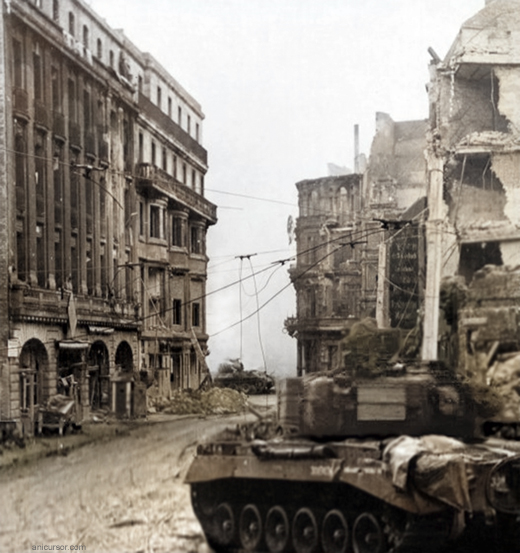
Photo montage of images of the Signal Corps and Archives NARA.
This is the sight that an observer might have had in this moment. The two tanks were facing. The panther is lurking in the background and in the foreground the Pershing moves into the intersection.
Both tanks are in direct visual contact now. The first shot now will decide the fate of the other tank, the fate of five soldiers and their families.
What's the reason the Panther didn't shot immediately ?
As the Pershing gunner Smoyer said, the gun was turning to meet the Pershing.
What's the reason the Panther crew hesitated ?
Panther commander Bartelborth is already dead, so you can not ask him. His daughter, however, told in the documentary "Köln 1945 Nahaufnahmen" that her father had told the family during his lifetime, the tank that had appeared in that situation on the street corner, would have been a German tank. He probably expected a Sherman tank and the tank was not a Sherman tank. So he was very surprised.
And so it is clear that Bartelborth had not give the order to fire because he did not recognize the Pershing as an US tank immediately.
A German tank commander did not recognize an US tank ?
Well, the Pershing had his first appearance in Europe only a few weeks previously, and only in small numbers. Many soldiers did not know this new tank type. The flow of information at this time, near the end of the war, was not comparable with the present times. Gunner Smoyer writes in his memoirs on the 3ad.com website:
"U.S. troops and German civilians were in awe of seeing the M26. Some troops thought it was a captured German tank."
Quelle: 3ad.com
|
Even US soldiers mixed up the Pershing with a German tank sometimes! Thus, it is not so far-fetched that even the German tank commander Bartelborth was wrong in thinking ...
In any case this delay is crucial for the fate of the German tank. Fractions of seconds decide between life and death.
|
 Overview battle area Overview battle area 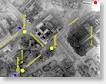
|
| |
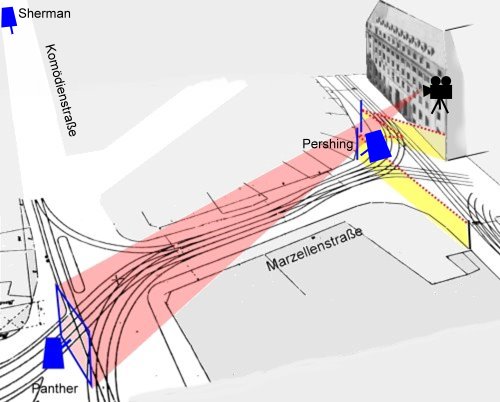
On the right side the building of the Deutsche Arbeitsfront where Jim Bates filmed the Panther in his tank duel movie. The Panther tank location is marked blue on the left side. The Pershing now is located on the crossing in front of the building.Jim Bates: |
Cpl. Clarence Smoyer the gunner, did not wait for his tank to stop but fired before the gun was aimed at him.
|
|
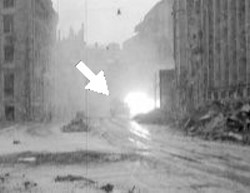
The Pershing tank drives to the crossing An den Dominikanern / Marzellenstrasse and fires toward the German Panther at the end of Marzellenstrasse. Distance between the two tanks: 110 m / 360 ft.
| |
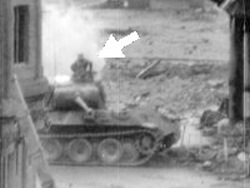
A crew member of the German tank flees. Movie pictures taken from cameraman James Bates
|



